EPUB format decision
Fixed-layout vs reflowable EPUB
Choose reflowable for text that should adapt to readers and screens. Choose fixed layout only when the meaning depends on exact page composition.
Definition and decision
What is a fixed-layout EPUB?
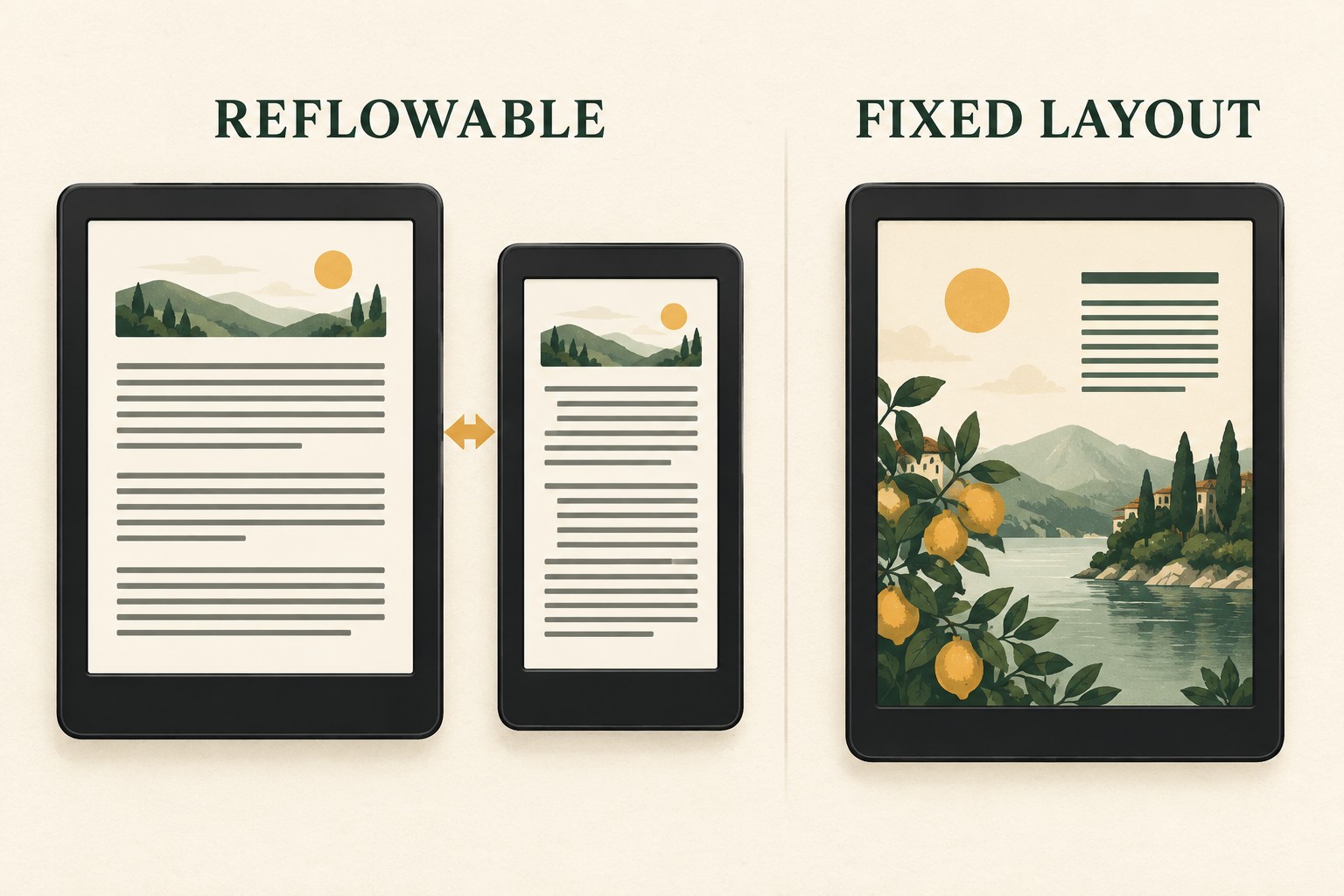
A fixed-layout EPUB is an EPUB 3 publication whose pages use a predetermined canvas instead of reflowing to the screen. Use it for picture books, comics and tightly designed educational pages; default to reflowable EPUB for novels, essays, manuals and most text-led books.
What changes for the reader?
| Question | Reflowable EPUB | Fixed-layout EPUB |
|---|---|---|
| Text size | Reader can usually resize it | Page is scaled as one canvas |
| Screen sizes | Text and images reflow | Composition stays fixed and may letterbox |
| Best for | Novels and text-led nonfiction | Picture books, comics and designed pages |
| Accessibility | Usually easier to support | Requires extra care and may limit controls |
| Maintenance | Styles can apply across chapters | Each page may need individual QA |
Use reflowable EPUB when content order matters more than coordinates
If a paragraph can move below an image without changing meaning, reflowable is normally the stronger choice. Readers gain font size, line spacing and margin controls. Search, text selection and assistive technology also have a clearer document structure to work with.
Use fixed layout when coordinates carry meaning
A speech bubble, map label, worksheet field or caption positioned over an illustration may lose meaning if it moves. Fixed layout preserves that relationship. The cost is that small screens may shrink the entire page, so text must remain legible or have an appropriate magnification experience.
Do not convert by flipping the layout flag
A reflowable chapter does not become a designed page when you add pre-paginated. You must define page dimensions, rebuild styles for a fixed canvas and test each page. Similarly, removing the flag from an image-based fixed-layout book will not produce semantic paragraphs.
Ask these questions before choosing
- Does the meaning depend on exact text-to-image placement?
- Can the smallest important text be read when the full page fits a phone?
- Is selectable text required?
- Must screen readers follow headings, paragraphs and lists?
- Can you test every page on multiple aspect ratios?
- Will the book be sold through KDP, shared as a personal document or distributed to several reading systems?
Choose the format before production
Late conversion is expensive because the two formats express different reading models. Keep semantic source text even when producing a fixed-layout edition, and consider a separate reflowable edition when accessibility or small-screen reading would otherwise suffer.
Already have a fixed-layout file?
Use the repair and validation guides to distinguish package errors from problems that require returning to the original page design.
Open the repair guide →Next guides
- Fix a broken fixed-layout EPUB
- Validate fixed-layout metadata and pages
- Understand Kindle fixed-layout limits